
 Posts
Posts


 figure of The Empress.
The RWS Three of Wands features a well-dressed man described as a knight standing on a cliff in front the sea. On either side of him, and slightly behind him are two staffs planted firmly in the ground, representing what exists, or perhaps what he has already accomplished. His right hand grasps a third staff, which is at his side. This staff can represent what is currently being accomplished. Staffs and wands generally represent energy and action. They are associated with the element of fire and the psychological function "feeling". The leaves on the three staffs of this card and all others in the deck, symbolize life energy, or that which motivates us to action. This man featured on the card can be likened to a successful person who is involved in some new passion, perhaps religion or charitable causes.
In the Alchemical Tarot, Place has substituted the leaves on his staffs with fire, an allusion to its psychological function. In his Three of Staffs, a ship bearing the third staff moves toward shore, suggesting an outside source of power which is available to the querent. There is no figure present, as in the RWS, so we can assume that we are looking through the eyes of the man. Of special note in this card is the fact that the staff to our left is burned considerably shorter than the one to our right. Staffs and swords, and their corresponding functions and elements, are considered male, which belongs traditionally to the right. What may be suggested here is that the kind of feeling we are examining in this suit has less to do with experiencing emotion and more to do with judging values.
A sharp departure from these images is seen in the Thoth Tarot Deck, where three lotus wands representing primeval energy are shown. Crowley attributes the Sun in Aries to this card, indicating abundant solar (again, male) influence from the sign's ruler. Those acquainted with Eastern Alchemy will note the reference to "the primeval" as a recurring theme in the Taoist translations of the I-Ching, which posit the primeval as a source of untrammeled wisdom within all of us, something which those who follow the Tao should seek to reacquaint themselves with. The primeval is a kind of "paradise lost" which is within our reach, though it requires we follow certain processes, or ways of thinking and acting, if we are to attain it. Of note in this image is the fact that the lotus wands do not overlap, they seem to merge together. There is no trumping of the left or right here, male and female converge, as both are capable of manifesting this energy. This concept is also reflected in the wands themselves, which are phallic, yet topped with a traditionally feminine flower.
The lotus wand is held in the right hand of The Empress, Atu 3. She is a symbol of Feminine Authority, or the exoteric feminine, such as mother, wife, and queen. Crowley says she is in "the traditional position", which appears to be one conveying modesty, though he attributes it to the sign for alchemical salt, or inactive earth. Actually, her seating more closely resembles the Hebrew letter lamed, which is given to Adjustment(Justice). In the instruction booklet, teth is incorrectly listed with Adjustment.

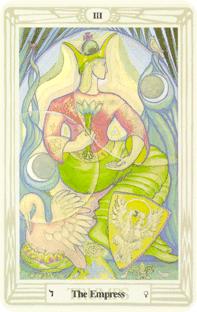
The heraldic white eagle at her feet is also a symbol for salt in alchemy. This, in conjunction with her pose, is an odd motif for a symbol which also includes fertility. An abundance of salt in nature is usually a deterrent to growth, so part of this could be tied into Crowley's own personal interpretations. I won't comment further, as there are others far more qualified to discuss Crowley than I am. But I will say: this figure is a far cry from Babalon, as shown in Atu 11.
Place's Alchemical Empress, by contrast, is the picture of fertility. She is the recurring White Queen of traditional western alchemy, and she stands by a fruit-bearing tree, naked except for her silver crown. She has created, as evidenced by the toddler standing by her, and has thus fulfilled her numerological attribution. In the mythic concept of the three witches of Fate, should could represent the mother, or present. Of the Norn, she is Verdandi. In the rest of the Tarot, she is most closely tied to the Queen of Coins, feminine ruler of the element earth.
Finally, we come to Smith's rendering of The Empress, which is somewhere between Crowley's and Place's on the sensuality scale. The Empress here is seated similarly to Crowley's, yet she is

looking to us, and there is no reference to salt, or anything else indicating sterility. In fact, she shares the Alchemical Empress's connection to fruit and vegetation, as there is an abundance of wheat in the foreground and opened pomegranates on her robe. She holds the phallic scepter in her right hand, but under it rests the symbol of Venus, goddess of fertility, on a heart-shaped shield. The heart shape is believed by some to allude to the female buttocks and pubic crease.
All of these images tie in to the concept of creation and creative energy. Next, we will examine Three in the suit of cups.
J.M.

