
 Posts
Posts


God's Notebook:
An Introduction to the Tarot
Introduction, History, Development, Theory, and Practice
The history of the Tarot is a reflection of our common histories, our evolving values, our place in the world. The rich abundance of symbols which are featured in the traditional Western decks evolved from the mythologies of Ancient Egypt and earlier influencing cultures. The Tarot, whether used for divination, meditation, or as a study of our symbolic past, is a profound work of art which has expressed itself through various and diverse images, yet consistently conveyed the ideas which are most important to any society.
Introduction and History
In this class, we will consider the earliest history of the Tarot, its connections to art and philosophy, and the lineage of our modern decks. This is an introductory class and does not require any prior experience or knowledge of divination or the Tarot.
Call 407-371-9665 for details
Saturday, July 10, 2010

Thursday, February 11, 2010
Never rule out the oblivion
Instead of continuing with our analysis of the number three, as it applies to the suit of cups, I would like to take a brief detour and discuss a recent reading which illustrates the importance of considering the obvious, or sometimes not-so-obvious. Or, I should say- the importance of considering what I'll refer to here as the outliers. An outlier is an observation which "lies outside" the usual field of data. It is the significantly improbable. Significant, however, because those observing are often then pressed to reconsider their study parameters, and investigate why such a deviation occurred.
In September of last year (2009), I did a personal reading for the sake of acquiring information about a friend who was suffering from drug and alcohol dependency. At the time of the reading, they had been coaxed into a rehabilitation program, and I wanted an idea of whether this person would work with the treatment and make an honest effort to help themselves and their family. I doubted they would, but rather than assume all was lost, I made an effort to see if there was anything her friends or family could do that hadn't already been tried, perhaps an angle nobody had considered.
This person was also involved in a dangerous relationship with another user, and I wanted to know the exact nature of the relationship, as well as whether the two people would continue the relationship after the rehabilitation stay was completed. I figured the chances of the person in rehab staying drug and alcohol free would be slim to none if they resumed the relationship, even if it was more casual than some of us assumed.
If I remember correctly, I broke the reading down into three separate questions, consisting of what result the effort to rehabilitate would have, both long and short term; what the nature of the relationship between the two people consisted of; and would the two people reunite, if so, when and to what effect on the person in rehab? The drawings consisted of three-card spreads with supplemental cards drawn for elaboration for the first and third questions, and a nine-card spread for the second.
Without going into details, most of the information gleaned was unsurprising. My assumptions were correct, for the most part, and I was able to verify this at a later date. Something troubled me about a particular card, however, and this was the Death card. It was laid down as part of the last spread, and I immediately assumed it referred to a time line, more specifically as reference to the end or death of the year. This would make sense when you consider the year-end holidays are usually a time when people contact friends and family they may not visit during the rest of the year. It could be that the holidays would be a likely time for these two to bump into each other and...celebrate? But something didn't feel quite right. I didn't want the card to mean the actual death of this person even though they had been warned of the eventual consequences of their habits. This card had never before meant such a thing, and that made it, along with what it actually signified, an outlier.
Another strange detail of the first reading should have been a clue for me, being that no understandable information could be interpreted on the long term effects of the treatment effort, only that the person would improve if they stayed away from the friends who also used. Which was practically a no-brainer.
Approximately two months later this person died. They never saw the end of 2009. I won't say anything more than that they didn't work with the mandates to stay away from the other friends who used.
So, sometimes a Death card really does mean actual death of a person. As readers, we owe it to ourselves to consider this possibility when it's appropriate, perhaps even telling a client if our discretion permits.
In my own case, I seriously doubt anything would've stopped the person from dying, as they had been warned by physicians and those closest to them. Death is an inevitability for now, for all of us, but some people move toward it very quickly and without heed.
As a phenomenon in my own experiences of reading Tarot, this example is an outlier, as the Death card has never held this meaning for me prior to last Sep. It forced me to reexamine that reading and include the possibility for future readings. The Death card now holds greater personal significance.
J.M.

In September of last year (2009), I did a personal reading for the sake of acquiring information about a friend who was suffering from drug and alcohol dependency. At the time of the reading, they had been coaxed into a rehabilitation program, and I wanted an idea of whether this person would work with the treatment and make an honest effort to help themselves and their family. I doubted they would, but rather than assume all was lost, I made an effort to see if there was anything her friends or family could do that hadn't already been tried, perhaps an angle nobody had considered.
This person was also involved in a dangerous relationship with another user, and I wanted to know the exact nature of the relationship, as well as whether the two people would continue the relationship after the rehabilitation stay was completed. I figured the chances of the person in rehab staying drug and alcohol free would be slim to none if they resumed the relationship, even if it was more casual than some of us assumed.
If I remember correctly, I broke the reading down into three separate questions, consisting of what result the effort to rehabilitate would have, both long and short term; what the nature of the relationship between the two people consisted of; and would the two people reunite, if so, when and to what effect on the person in rehab? The drawings consisted of three-card spreads with supplemental cards drawn for elaboration for the first and third questions, and a nine-card spread for the second.
Without going into details, most of the information gleaned was unsurprising. My assumptions were correct, for the most part, and I was able to verify this at a later date. Something troubled me about a particular card, however, and this was the Death card. It was laid down as part of the last spread, and I immediately assumed it referred to a time line, more specifically as reference to the end or death of the year. This would make sense when you consider the year-end holidays are usually a time when people contact friends and family they may not visit during the rest of the year. It could be that the holidays would be a likely time for these two to bump into each other and...celebrate? But something didn't feel quite right. I didn't want the card to mean the actual death of this person even though they had been warned of the eventual consequences of their habits. This card had never before meant such a thing, and that made it, along with what it actually signified, an outlier.
Another strange detail of the first reading should have been a clue for me, being that no understandable information could be interpreted on the long term effects of the treatment effort, only that the person would improve if they stayed away from the friends who also used. Which was practically a no-brainer.
Approximately two months later this person died. They never saw the end of 2009. I won't say anything more than that they didn't work with the mandates to stay away from the other friends who used.
So, sometimes a Death card really does mean actual death of a person. As readers, we owe it to ourselves to consider this possibility when it's appropriate, perhaps even telling a client if our discretion permits.
In my own case, I seriously doubt anything would've stopped the person from dying, as they had been warned by physicians and those closest to them. Death is an inevitability for now, for all of us, but some people move toward it very quickly and without heed.
As a phenomenon in my own experiences of reading Tarot, this example is an outlier, as the Death card has never held this meaning for me prior to last Sep. It forced me to reexamine that reading and include the possibility for future readings. The Death card now holds greater personal significance.
J.M.
Tuesday, January 12, 2010
The Number Three (part 3) Wands and The Empress
Three implies creation in numerology. Artistry, enterprise, synergy, these three ideas intertwine as aspects of creation. They also necessitate cooperation if they are to serve their purpose, as every artist and entrepreneur has a muse, through which they create something greater than is (hopefully) the sum of their individual parts: a synergy. Naturally, there is also the raw material which is used in the making of something: be it paint, canvas, brush, etc. or buildings, employees, machinery, capitol, etc.- which would constitute a necessary fourth component in creation. The number four, by the way, is associated with matter and establishment. We will perhaps explore that in a later entry. For now, we will focus on the number three in the suit of Wands and the  figure of The Empress.
The RWS Three of Wands features a well-dressed man described as a knight standing on a cliff in front the sea. On either side of him, and slightly behind him are two staffs planted firmly in the ground, representing what exists, or perhaps what he has already accomplished. His right hand grasps a third staff, which is at his side. This staff can represent what is currently being accomplished. Staffs and wands generally represent energy and action. They are associated with the element of fire and the psychological function "feeling". The leaves on the three staffs of this card and all others in the deck, symbolize life energy, or that which motivates us to action. This man featured on the card can be likened to a successful person who is involved in some new passion, perhaps religion or charitable causes.
In the Alchemical Tarot, Place has substituted the leaves on his staffs with fire, an allusion to its psychological function. In his Three of Staffs, a ship bearing the third staff moves toward shore, suggesting an outside source of power which is available to the querent. There is no figure present, as in the RWS, so we can assume that we are looking through the eyes of the man. Of special note in this card is the fact that the staff to our left is burned considerably shorter than the one to our right. Staffs and swords, and their corresponding functions and elements, are considered male, which belongs traditionally to the right. What may be suggested here is that the kind of feeling we are examining in this suit has less to do with experiencing emotion and more to do with judging values.
A sharp departure from these images is seen in the Thoth Tarot Deck, where three lotus wands representing primeval energy are shown. Crowley attributes the Sun in Aries to this card, indicating abundant solar (again, male) influence from the sign's ruler. Those acquainted with Eastern Alchemy will note the reference to "the primeval" as a recurring theme in the Taoist translations of the I-Ching, which posit the primeval as a source of untrammeled wisdom within all of us, something which those who follow the Tao should seek to reacquaint themselves with. The primeval is a kind of "paradise lost" which is within our reach, though it requires we follow certain processes, or ways of thinking and acting, if we are to attain it. Of note in this image is the fact that the lotus wands do not overlap, they seem to merge together. There is no trumping of the left or right here, male and female converge, as both are capable of manifesting this energy. This concept is also reflected in the wands themselves, which are phallic, yet topped with a traditionally feminine flower.
The lotus wand is held in the right hand of The Empress, Atu 3. She is a symbol of Feminine Authority, or the exoteric feminine, such as mother, wife, and queen. Crowley says she is in "the traditional position", which appears to be one conveying modesty, though he attributes it to the sign for alchemical salt, or inactive earth. Actually, her seating more closely resembles the Hebrew letter lamed, which is given to Adjustment(Justice). In the instruction booklet, teth is incorrectly listed with Adjustment.
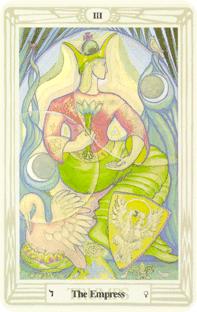
The heraldic white eagle at her feet is also a symbol for salt in alchemy. This, in conjunction with her pose, is an odd motif for a symbol which also includes fertility. An abundance of salt in nature is usually a deterrent to growth, so part of this could be tied into Crowley's own personal interpretations. I won't comment further, as there are others far more qualified to discuss Crowley than I am. But I will say: this figure is a far cry from Babalon, as shown in Atu 11.
Place's Alchemical Empress, by contrast, is the picture of fertility. She is the recurring White Queen of traditional western alchemy, and she stands by a fruit-bearing tree, naked except for her silver crown. She has created, as evidenced by the toddler standing by her, and has thus fulfilled her numerological attribution. In the mythic concept of the three witches of Fate, should could represent the mother, or present. Of the Norn, she is Verdandi. In the rest of the Tarot, she is most closely tied to the Queen of Coins, feminine ruler of the element earth.
Finally, we come to Smith's rendering of The Empress, which is somewhere between Crowley's and Place's on the sensuality scale. The Empress here is seated similarly to Crowley's, yet she is
looking to us, and there is no reference to salt, or anything else indicating sterility. In fact, she shares the Alchemical Empress's connection to fruit and vegetation, as there is an abundance of wheat in the foreground and opened pomegranates on her robe. She holds the phallic scepter in her right hand, but under it rests the symbol of Venus, goddess of fertility, on a heart-shaped shield. The heart shape is believed by some to allude to the female buttocks and pubic crease.
All of these images tie in to the concept of creation and creative energy. Next, we will examine Three in the suit of cups.
J.M.
figure of The Empress.The RWS Three of Wands features a well-dressed man described as a knight standing on a cliff in front the sea. On either side of him, and slightly behind him are two staffs planted firmly in the ground, representing what exists, or perhaps what he has already accomplished. His right hand grasps a third staff, which is at his side. This staff can represent what is currently being accomplished. Staffs and wands generally represent energy and action. They are associated with the element of fire and the psychological function "feeling". The leaves on the three staffs of this card and all others in the deck, symbolize life energy, or that which motivates us to action. This man featured on the card can be likened to a successful person who is involved in some new passion, perhaps religion or charitable causes.
In the Alchemical Tarot, Place has substituted the leaves on his staffs with fire, an allusion to its psychological function. In his Three of Staffs, a ship bearing the third staff moves toward shore, suggesting an outside source of power which is available to the querent. There is no figure present, as in the RWS, so we can assume that we are looking through the eyes of the man. Of special note in this card is the fact that the staff to our left is burned considerably shorter than the one to our right. Staffs and swords, and their corresponding functions and elements, are considered male, which belongs traditionally to the right. What may be suggested here is that the kind of feeling we are examining in this suit has less to do with experiencing emotion and more to do with judging values.
A sharp departure from these images is seen in the Thoth Tarot Deck, where three lotus wands representing primeval energy are shown. Crowley attributes the Sun in Aries to this card, indicating abundant solar (again, male) influence from the sign's ruler. Those acquainted with Eastern Alchemy will note the reference to "the primeval" as a recurring theme in the Taoist translations of the I-Ching, which posit the primeval as a source of untrammeled wisdom within all of us, something which those who follow the Tao should seek to reacquaint themselves with. The primeval is a kind of "paradise lost" which is within our reach, though it requires we follow certain processes, or ways of thinking and acting, if we are to attain it. Of note in this image is the fact that the lotus wands do not overlap, they seem to merge together. There is no trumping of the left or right here, male and female converge, as both are capable of manifesting this energy. This concept is also reflected in the wands themselves, which are phallic, yet topped with a traditionally feminine flower.
The lotus wand is held in the right hand of The Empress, Atu 3. She is a symbol of Feminine Authority, or the exoteric feminine, such as mother, wife, and queen. Crowley says she is in "the traditional position", which appears to be one conveying modesty, though he attributes it to the sign for alchemical salt, or inactive earth. Actually, her seating more closely resembles the Hebrew letter lamed, which is given to Adjustment(Justice). In the instruction booklet, teth is incorrectly listed with Adjustment.
The heraldic white eagle at her feet is also a symbol for salt in alchemy. This, in conjunction with her pose, is an odd motif for a symbol which also includes fertility. An abundance of salt in nature is usually a deterrent to growth, so part of this could be tied into Crowley's own personal interpretations. I won't comment further, as there are others far more qualified to discuss Crowley than I am. But I will say: this figure is a far cry from Babalon, as shown in Atu 11.
Place's Alchemical Empress, by contrast, is the picture of fertility. She is the recurring White Queen of traditional western alchemy, and she stands by a fruit-bearing tree, naked except for her silver crown. She has created, as evidenced by the toddler standing by her, and has thus fulfilled her numerological attribution. In the mythic concept of the three witches of Fate, should could represent the mother, or present. Of the Norn, she is Verdandi. In the rest of the Tarot, she is most closely tied to the Queen of Coins, feminine ruler of the element earth.
Finally, we come to Smith's rendering of The Empress, which is somewhere between Crowley's and Place's on the sensuality scale. The Empress here is seated similarly to Crowley's, yet she is
looking to us, and there is no reference to salt, or anything else indicating sterility. In fact, she shares the Alchemical Empress's connection to fruit and vegetation, as there is an abundance of wheat in the foreground and opened pomegranates on her robe. She holds the phallic scepter in her right hand, but under it rests the symbol of Venus, goddess of fertility, on a heart-shaped shield. The heart shape is believed by some to allude to the female buttocks and pubic crease.
All of these images tie in to the concept of creation and creative energy. Next, we will examine Three in the suit of cups.
J.M.
Friday, January 1, 2010
The Number Three (part2) But first, some background...
Happy New Year!
Previously, I have showed how numbers in general can have various meanings depending on which context one is using, and how they can also be useful as a mnemonic, or memory aid when learning a system, whether divinatory or otherwise.
Before I begin to explore the meaning of the number three within the tarot, I should like to give a brief preface to what I am abo
In my previous post, I touched on the significance of three in the Tarot, particularly in reference to the "three card spread". I also shut to "get into" by way of introducing three different decks: the Waite-Smith(RWS), the Thoth, and the Alchemical Tarot(AT), which we will use to compare the generally understood and intended meanings of five different cards within those decks: "three of staffs", "three of swords", "three of cups", "three of coins", and last, but certainly not least, the third card of the Greater Mysteries: The Empress. We will explore these cards, noting differences and similarities between decks and between suits within a deck and with a general idea of what "three", as a living, breathing concept embodies.
Let me start by saying that there is no fixed standard by which all Tarot decks measure. What is now commonly called the Waite-Smith deck, designed by Arthur Edward Waite, illustrated by Pamela Coleman Smith and published in 1909, is probably considered the most popular Tarot deck here in the U.S. Many designers will model the meanings and general imagery of their deck's minor arcana according to the RWS deck, which is closely modeled after the much older Sola Busca deck, believed to have been created in the later half of the fifteenth century, and named after a wealthy Venetian family.
The popularity of the Waite-Smith deck is due largely to two factors: the simplicity of Smith's illustrations, which are deceivingly rich in meaning and symbolism, and the influential status of Waite, who was well respected within the Golden Dawn, a magical order that included the likes of William Butler Yeats, Aleister Crowley, Arthur Machen, and Bram Stoker. Due to its popularity and influence, I will include the Waite-Smith deck here.
Crowley, a fellow member of the Golden Dawn, eventually struck out on his own as many other members had, eventually forming the group Astrum Argentum and collaborating with fellow Briton and occultist Lady Freida Harris on The Book of Thoth and Thoth deck. The Thoth deck utilizes Qabala and Thelemic motifs, and features extensive use of astrology association.
Modern tarot scholar and creator Robert Place is well known for his definitive explanation of the art in "The Tarot: History, Symbolism, and Divination" as well as several beautifully illustrated decks, one of which we shall include in this discussion. The Alchemical Tarot is a modern deck which incorporates traditional alchemical images and meanings into the cards. Tarot imagery has its roots in Neoplatonism, of which alchemy shares lineage, so the marriage of the two is quite natural.
In the next post, we will jump into the meanings of those cards and begin a discussion of comparison for the sake of better understanding how the number three plays into the tarot.
J.M.
Previously, I have showed how numbers in general can have various meanings depending on which context one is using, and how they can also be useful as a mnemonic, or memory aid when learning a system, whether divinatory or otherwise.
Before I begin to explore the meaning of the number three within the tarot, I should like to give a brief preface to what I am abo
In my previous post, I touched on the significance of three in the Tarot, particularly in reference to the "three card spread". I also shut to "get into" by way of introducing three different decks: the Waite-Smith(RWS), the Thoth, and the Alchemical Tarot(AT), which we will use to compare the generally understood and intended meanings of five different cards within those decks: "three of staffs", "three of swords", "three of cups", "three of coins", and last, but certainly not least, the third card of the Greater Mysteries: The Empress. We will explore these cards, noting differences and similarities between decks and between suits within a deck and with a general idea of what "three", as a living, breathing concept embodies.
Let me start by saying that there is no fixed standard by which all Tarot decks measure. What is now commonly called the Waite-Smith deck, designed by Arthur Edward Waite, illustrated by Pamela Coleman Smith and published in 1909, is probably considered the most popular Tarot deck here in the U.S. Many designers will model the meanings and general imagery of their deck's minor arcana according to the RWS deck, which is closely modeled after the much older Sola Busca deck, believed to have been created in the later half of the fifteenth century, and named after a wealthy Venetian family.
The popularity of the Waite-Smith deck is due largely to two factors: the simplicity of Smith's illustrations, which are deceivingly rich in meaning and symbolism, and the influential status of Waite, who was well respected within the Golden Dawn, a magical order that included the likes of William Butler Yeats, Aleister Crowley, Arthur Machen, and Bram Stoker. Due to its popularity and influence, I will include the Waite-Smith deck here.
Crowley, a fellow member of the Golden Dawn, eventually struck out on his own as many other members had, eventually forming the group Astrum Argentum and collaborating with fellow Briton and occultist Lady Freida Harris on The Book of Thoth and Thoth deck. The Thoth deck utilizes Qabala and Thelemic motifs, and features extensive use of astrology association.
Modern tarot scholar and creator Robert Place is well known for his definitive explanation of the art in "The Tarot: History, Symbolism, and Divination" as well as several beautifully illustrated decks, one of which we shall include in this discussion. The Alchemical Tarot is a modern deck which incorporates traditional alchemical images and meanings into the cards. Tarot imagery has its roots in Neoplatonism, of which alchemy shares lineage, so the marriage of the two is quite natural.
In the next post, we will jump into the meanings of those cards and begin a discussion of comparison for the sake of better understanding how the number three plays into the tarot.
J.M.
Monday, December 28, 2009
The Number Three
"it appears that whole numbers are individuals, and that they possess properties which cannot be explained on the assumption that they are multiple units. The idea that numbers were invented for counting is obviously untenable, since they are not only pre-existent to judgement but possess properties which are discovered only in the course of the centuries, and presumably possess a number of others which will be brought to life by the future developments in mathematics."
Carl Jung
In numerology, the number three implies creation, following from the idea that humans require a man and woman (2) to reproduce. So three can represent, in a simple sense, a family unit. Three points move one dimensionally from a line to a plane. From three points we may also produce a triangulation, or a convenient point of reference in observation.
In Tarot readings, three cards comprise a useful spread, upon which all other spreads are usually founded. When reading cards in a three card spread, attention is paid to the motion in which information seems to be traveling, whether it be from left to right, right to left, out from the center card, toward the center from either end card, or several other fragmented or interrupted variations. In a well-understood reading, the information is almost always comprised of relationships between at least two of the three cards.
As C.G. Jung noted in the above quote, numbers themselves should be understood as often holding a deeper significance than simple measuring units, for they often hold important symbolic meaning to the observer, especially during a dream, instance of inspiration, or any other time in which the observer would typically feel as though there may be significance attached to a number. In a card reading, the numbering of the particular card should be noted, whether belonging to the minor or major arcana, this is where at good base of numerology knowledge comes in handy. Since most divination systems, like language, rely on an understanding of common symbols, it would actually behoove one to become familiar with as many basic ideas in what is commonly referred to as "the occult" as well as popular world religions, and notice the common denominators such as numbers and shapes which provide a kind of shorthand in communicating and receiving information between people of varying backgrounds and ideologies. For instance, three, to a Christian, may bring to mind the Trinity. To a Buddhist it can refer to the "three worlds" or "realms", being: The Desire Realm, The Form Realm, and The Formless Realm. Or it may represent "Three Bodies" or Trikaya. In Zen, it can refer to the three pillars of teaching, practice, and enlightenment. Three pillars also figure prominently into Qabala, dividing the ten sephiroth of the Tree of Life into "male", "female", and "neutral" aspects. And on and on.
You may note that the above examples of religious study may be divided into three different categories: Occidental (Christian), Oriental (Buddhism and Zen), and a sort of western adaptation of a traditionally eastern discipline (Qabala). Though, to be fair, Zen is more of a philosophy than a religion.
In the next post, I'll focus in on the number three as expressed specifically in the Tarot.
J.M.
Carl Jung
In numerology, the number three implies creation, following from the idea that humans require a man and woman (2) to reproduce. So three can represent, in a simple sense, a family unit. Three points move one dimensionally from a line to a plane. From three points we may also produce a triangulation, or a convenient point of reference in observation.
In Tarot readings, three cards comprise a useful spread, upon which all other spreads are usually founded. When reading cards in a three card spread, attention is paid to the motion in which information seems to be traveling, whether it be from left to right, right to left, out from the center card, toward the center from either end card, or several other fragmented or interrupted variations. In a well-understood reading, the information is almost always comprised of relationships between at least two of the three cards.
As C.G. Jung noted in the above quote, numbers themselves should be understood as often holding a deeper significance than simple measuring units, for they often hold important symbolic meaning to the observer, especially during a dream, instance of inspiration, or any other time in which the observer would typically feel as though there may be significance attached to a number. In a card reading, the numbering of the particular card should be noted, whether belonging to the minor or major arcana, this is where at good base of numerology knowledge comes in handy. Since most divination systems, like language, rely on an understanding of common symbols, it would actually behoove one to become familiar with as many basic ideas in what is commonly referred to as "the occult" as well as popular world religions, and notice the common denominators such as numbers and shapes which provide a kind of shorthand in communicating and receiving information between people of varying backgrounds and ideologies. For instance, three, to a Christian, may bring to mind the Trinity. To a Buddhist it can refer to the "three worlds" or "realms", being: The Desire Realm, The Form Realm, and The Formless Realm. Or it may represent "Three Bodies" or Trikaya. In Zen, it can refer to the three pillars of teaching, practice, and enlightenment. Three pillars also figure prominently into Qabala, dividing the ten sephiroth of the Tree of Life into "male", "female", and "neutral" aspects. And on and on.
You may note that the above examples of religious study may be divided into three different categories: Occidental (Christian), Oriental (Buddhism and Zen), and a sort of western adaptation of a traditionally eastern discipline (Qabala). Though, to be fair, Zen is more of a philosophy than a religion.
In the next post, I'll focus in on the number three as expressed specifically in the Tarot.
J.M.
Subscribe to:
Comments (Atom)
